
A“Nuclear World” refers to the use of nuclear energy in generating electricity to meet the energy demands of people. Instead of being largely dependent on fossil fuels such as coal, oil and natural gas, nuclear reactors will generate most of the energy that can be tapped for electrical purposes. Thus, in a nuclear world, a move towards a cleaner source of energy production through high-tech science and technology will take place to meet the increasing energy requirements while reducing the amount of air pollution. However, a nuclear world entails stringent safety measures to address the problems associated with nuclear radiation and accidents.
In 1951 the first electricity from a nuclear plant was generated in Idaho. Today over 400 reactors in 26 countries produce about 200,000 MW of electric power, the equivalent of nearly 10 million barrels of oil per day. France, Belgium and Taiwan obtain more than half their electricity from reactors, with several other countries close behind (Fig: 1.00). In the United States, nuclear energy is responsible for 21 percent of generated electricity, slightly more than the world average; there are 103 reactors in 31 states. Yet for all the success of nuclear technology, no new nuclear power stations have been planned in this country since 1979. Why not?
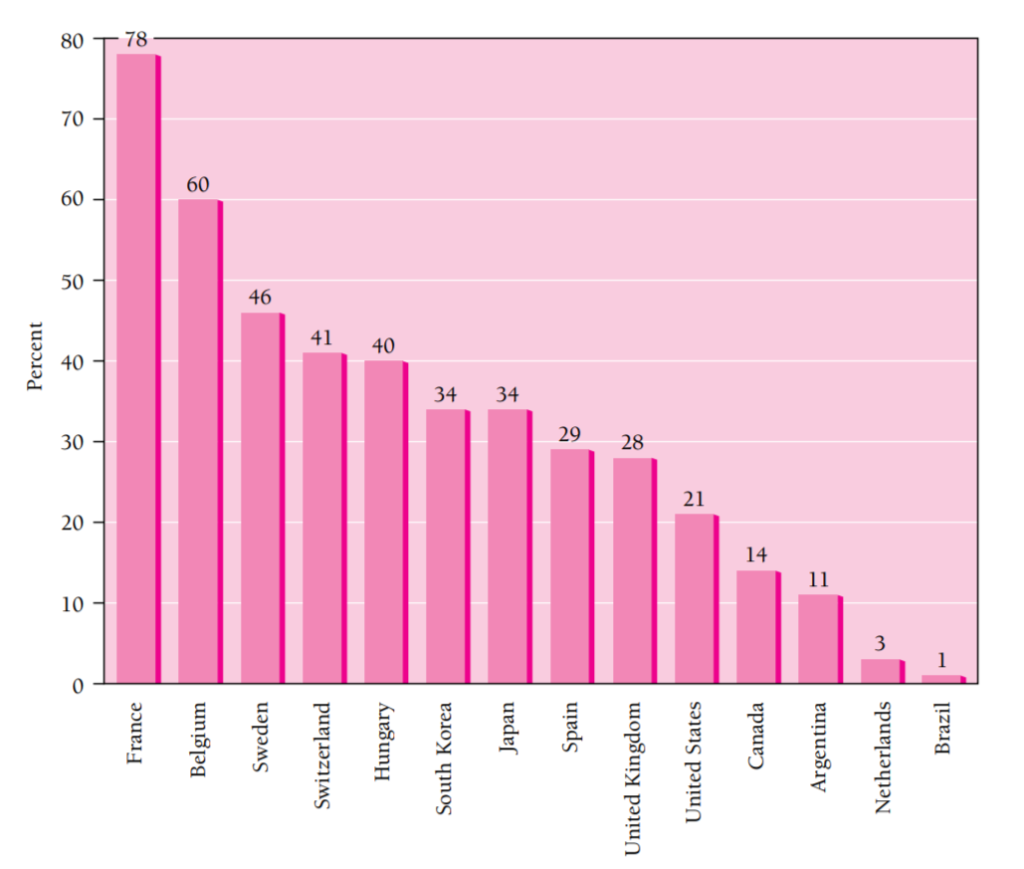
Percentage of electric energy in various countries that comes from nuclear power stations.
Figures are for 1997.
In March 1979, failures in its cooling system disabled one of the reactors at Three Mile Island in Pennsylvania and a certain amount of radioactive material escaped. Although a nuclear reactor cannot explode in the way an atomic bomb does, breakdowns can occur that put large populations at risk. Although a true catastrophe was narrowly avoided, the Three Mile Island incident made it clear that the hazards associated with nuclear energy are real.
After 1979, it was inevitable that greater safety would have to be built into new reactors, adding to their already high cost. In addition, demand for electricity in the United States was not increasing as fast as expected, partly because of efforts toward greater efficiency and partly because of a decline in some industries (such as steel, cars and chemicals) that are heavy users of electricity. As a result of these factors, new reactors made less economic sense than before, which together with widespread public unease led to a halt in the expansion of nuclear energy in the United States.
Elsewhere the situation was different. Nuclear reactors still seemed the best way to meet the energy needs of many countries without abundant fossil fuel resources. Then in April 1986, a severe accident destroyed a 1000 MW reactor at Chernobyl in what is now Ukraine, then part of the Soviet Union. This was the worst environmental disaster of technological origin in history and contributed to the collapse of the Soviet Union. Over 50 tons of radioactive material escaped and was carried around the world by winds. The radiation released was nearly 200 times the total given off by the Hiroshima and Nagasaki atomic bombs in 1945. Radiation levels in much of Europe rose well above normal for a time and a quarter of a million people were permanently evacuated from the vicinity of Chernobyl. A number of reactor, rescue and cleanup workers died soon afterward as a result of exposure to radiation and thousands more became ill. Widespread contamination with radionuclides, particularly of food and water supplies, suggests that cancer will raise the total of people affected manyfold in the years to come. Already about a thousand children, who are especially susceptible, have developed thyroid cancer as a result of ingesting the radioactive iodine isotope ¹³¹I. A third of all the children living near Chernobyl who were under 4 years old in 1986 are expected to come down with thyroid cancer eventually.
As in the United States after Three Mile Island, public anxiety over the safety of nuclear programs grew in Europe after Chernobyl. Some countries, for instance Italy, abandoned plans for new reactors. In other countries, for instance France, the logic behind their nuclear programs remained strong enough for them to continue despite Chernobyl.
Quite apart from the safety of reactors themselves is the issue of what to do with the wastes they produce. Even if old fuel rods are processed to separate out the uranium and plutonium they contain, what is left is still highly radioactive. Although a lot of the activity will be gone in a few months and much of the rest in a few hundred years, some of the radionuclides have half lives in the millions of years. At present perhaps 20,000 tons of spent nuclear fuel is being stored on a temporary basis in the United States (not to mention the vast amount of highly radioactive waste left over from nuclear weapons manufacture that is also awaiting safe storage). Burying nuclear wastes deep underground currently seems to be the best long term way to dispose of them. The right location is easy to specify but difficult to find because it must be geologically stable where earthquakes are unlikely, it should be far from populated areas, the rock must be strong enough to withstand heat and radiation without breaking down while still being easy to drill into and it should not be close to any groundwater that could become contaminated.
From today’s perspective, nuclear energy has important advantages not fully appreciated in the past such as it does not produce the air pollution that fossil fuel burning does, nor the huge quantities of carbon dioxide that are the main contributor to global warming via the greenhouse effect. Together with the rising cost of fossil fuels and increasing demand for electricity, these factors seem likely to lead to the construction of new nuclear reactors in the United States after a delay of over two decades.
Source:“Concept of Modern Physics” by Arthur Beiser